Differences Between Standard and Deep Cleaning | Sergeant Suds
Colorado Springs facility managers ask this question often, and it makes complete sense. On the surface, both services involve a professional cleaning crew working through a commercial space. Underneath, each one is built for a completely different purpose, and treating them as interchangeable tends to cause real problems for the facility and frustration for everyone managing it.
That distinction matters more than most people realize, especially for those who rely on deep cleaning services in Colorado Springs, CO to maintain a safe and fully operational space.
The Short Answer: Two Different Jobs, Two Different Goals
A standard janitorial schedule is maintenance work. The job is to keep a facility clean, presentable, and sanitary at the surface level on a recurring basis. Deep janitorial cleaning is about resetting the facility, working through the areas that regular service doesn't reach and addressing the buildup that accumulates over weeks or months.
They are not competing services. A facility that runs a consistent standard janitorial schedule and skips deep cleaning ends up with grime accumulating in hard-to-reach areas that the maintenance crew isn't equipped to address within a typical visit window. A facility that gets periodic deep cleans without a regular maintenance schedule in between loses the benefit of those deep cleans faster than it should. They work together, and the combination is where the best results come from.
What Standard Janitorial Service Actually Covers
Standard janitorial service covers the visible, high-traffic areas of a commercial facility on a consistent schedule. This is the work that keeps a space functional and presentable between deeper cleaning cycles.
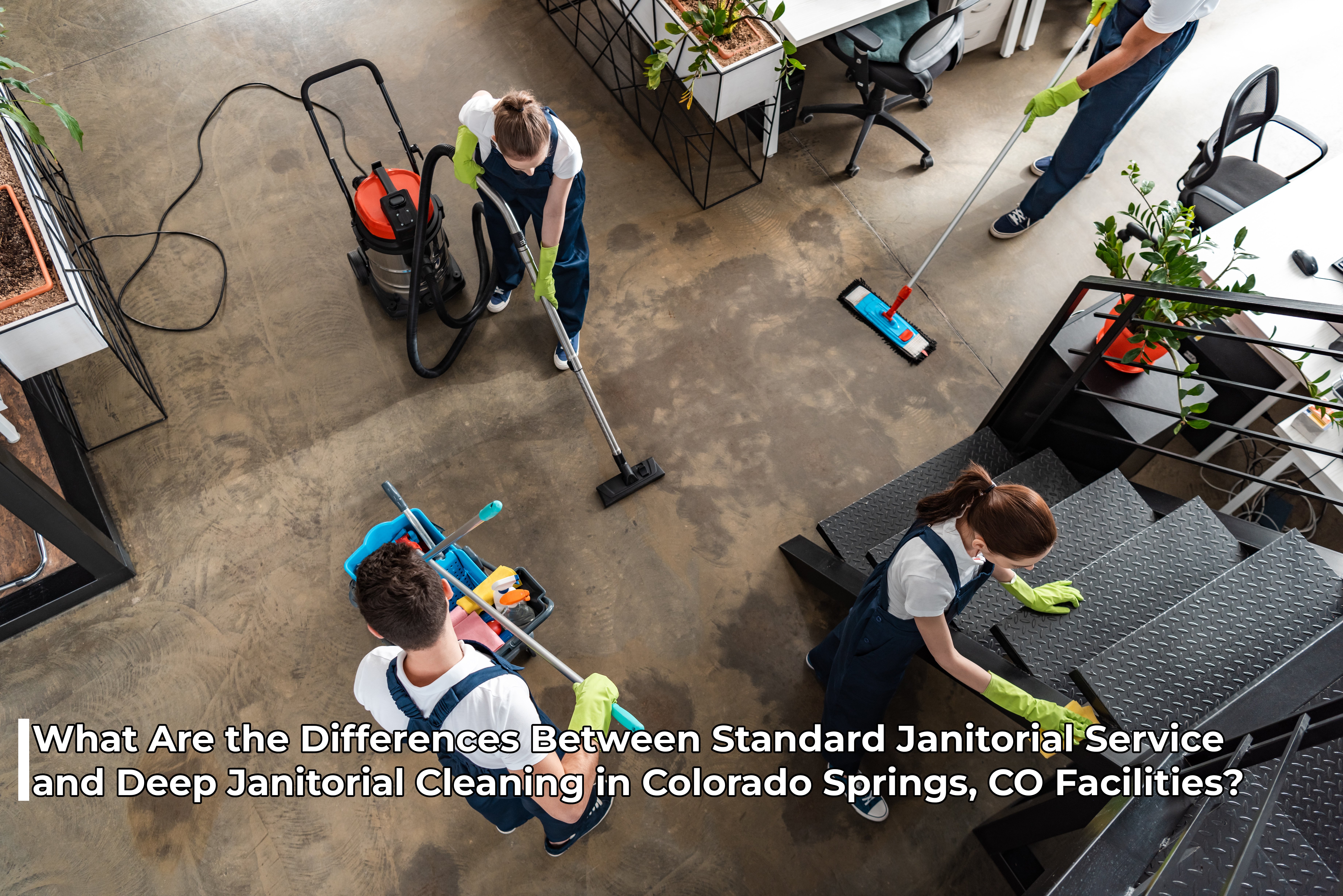
A typical recurring janitorial visit at a Colorado Springs office or commercial property covers emptying and relining trash receptacles, sweeping, vacuuming, and mopping floor surfaces, wiping down desks and visible work surfaces, cleaning restroom fixtures including toilets, urinals, sinks, mirrors, and floors, restocking paper products and hand soap, and maintaining common areas like lobbies, break rooms, and conference rooms. These tasks are manageable within the time window of a maintenance visit. They address what is visible and what accumulates quickly. They are not designed to go deeper than that, and the time allocated for a standard visit does not allow for it.
What Deep Janitorial Cleaning Adds
Deep janitorial cleaning addresses the buildup that routine visits cannot reasonably reach. In a Colorado Springs commercial facility, that means working through grout lines in restrooms and kitchen areas, cleaning the interior of break room appliances, getting behind and beneath heavy equipment and furniture, washing walls, baseboards, and door frames, cleaning interior windows and window sills, descaling faucets and fixtures, cleaning HVAC vents, diffusers, and air return covers, and detail-sanitizing high-touch surfaces well beyond a standard wipe.
The scope is broader, and the time required is proportionally longer. A deep cleaning crew is working through areas that may not have been properly addressed in months. That is not a failure of standard janitorial service. It is simply what happens over time in a busy commercial facility, and it is what deep cleaning is there to correct.
Why Treating Them as the Same Service Creates Problems
When a Colorado Springs facility manager expects standard janitorial service to deliver deep-clean results, the cleaning crew is set up to fail before they start. The time allocated for a maintenance visit is not enough to work through areas that require dedicated deep cleaning attention. Crews end up rushing lower-priority areas to stay on schedule, and the facility never gets the reset it actually needs.
The reverse problem is just as real. Over-scheduling deep cleans and skipping consistent maintenance between them means the facility gets a thorough clean periodically but deteriorates faster than expected in between because there is no maintenance work holding the standard. The cost goes up, and the results do not match the investment.
Which One Does Your Colorado Springs Facility Need Right Now?

The answer depends on the current condition of the facility, the last time a thorough deep clean was done, and the type of business operating there.
Medical offices, food-handling environments, high-traffic retail locations, and facilities that have not had professional cleaning in a while typically need a deep clean before any recurring maintenance schedule makes sense. Starting a standard janitorial contract on a facility that has not been reset means the crew is constantly catching up rather than maintaining. A newer office that has been maintained consistently may only need standard recurring service with a scheduled deep clean every quarter or twice a year. The key is matching the service to the actual state and use of the facility.
How We Handle This at Sergeant Suds
We do not treat these as separate products. Our commercial cleaning services in Colorado Springs are built around what your facility actually needs, starting with an honest walkthrough assessment before we make any recommendations.
Every member of our team is background-checked, and we are fully bonded and insured on all commercial jobs. We are a veteran-owned, SDVOSB-certified business that has been cleaning Colorado Springs commercial facilities since 2014, and every job we take on is backed by a 100% satisfaction guarantee. Whether your facility needs a one-time deep clean to get back to baseline or a recurring maintenance schedule with periodic deep cleans built in, we put together a scope that fits the property.
Frequently Asked Questions About Janitorial Services in Colorado Springs
What is the difference between janitorial service and deep cleaning? Janitorial service covers recurring maintenance: trash removal, floor care, restroom sanitation, and surface cleaning on a consistent schedule. Deep cleaning is a separate, more intensive service that addresses buildup in areas that routine maintenance does not reach, including grout, baseboards, appliance interiors, HVAC vents, and spaces behind and beneath equipment.
How often should a Colorado Springs office schedule deep janitorial cleaning? Most offices benefit from a deep clean two to four times per year. High-traffic facilities often schedule quarterly. The right frequency depends on how many people use the space daily, what kind of activity happens there, and how well the standard janitorial schedule maintains the baseline between deep cleans.
Does a deep clean replace regular janitorial service? No. A deep clean resets the facility to a high standard, but it does not maintain it. Regular janitorial service is what keeps the space functional and presentable between those reset cycles. The two are designed to work together, not substitute for each other.
How long does a commercial deep clean take? It depends on the square footage, the current condition of the facility, and the agreed scope of work. A thorough deep clean of a mid-size Colorado Springs office typically runs several hours to a full workday. We can give a more accurate estimate after walking the space.
What types of Colorado Springs businesses benefit most from deep janitorial cleaning? Medical offices, dental practices, restaurants and food service operations, high-traffic retail locations, and any commercial facility that has not had a thorough deep clean in six months or more tend to see the biggest difference. That said, any business running standard janitorial service benefits from scheduled deep cleaning at regular intervals.
Get a Free Residential Cleaning Quote in Colorado Springs
The fastest way to know what your cleaning service will cost is to request a quote directly. The form takes about 60 seconds, the quote is written, and there are no obligations. Book your residential cleaning quote here or call our team at (719) 452-8403 during business hours, Monday through Saturday, 9 am to 6 pm.
Every clean is backed by our 100% satisfaction guarantee, and a portion of every service goes to the Wounded Warrior Project.
Related Topics:
